
Soft Magnetic Composites: An Overview
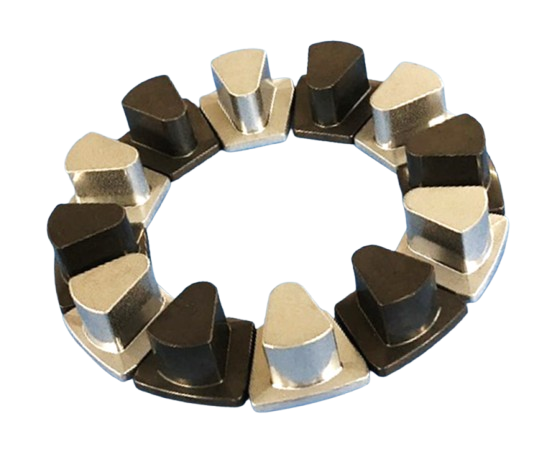
1. What Are Soft Magnetic Composites (SMCs)?
Soft Magnetic Composites (SMCs) are made from iron powder coated in a thin insulating layer.
They’re mainly used in electric motors, transformers, and other devices where controlling magnetic
fields is important, especially when things need to run efficiently at high speeds or frequencies.
If you're new to powder metallurgy (the process used to make these parts), check out these articles
for background: Introduction to Powder Metallurgy, Introduction to Metal Injection Molding,
Introduction to Sintered Oil Impregnated Bearings.
This article covers:
Applications
Properties
Advantages and Limitations
Visual Example
Conclusion and how Porite Group can help
2. Applications
A. Automotive Industry
Electric motors – Found in EVs for efficient, space-saving motor design
Electric pumps & compressors – Help regulate temperature in HVAC systems
Ignition systems & actuators – Enable quick, precise movements with little energy use
B. Industrial Applications
Solenoids & actuators – Provide fast responses in automation systems
Motors and drives – Improve efficiency in fans, pumps, and machines
Sensors – Used in devices that measure movement or position
C. Energy Sector
Wind turbines – Lightweight cores help make renewable energy more efficient
Solar inverters – Reduce energy losses in high-frequency electronics
D. Electronics
Transformers – Especially good in systems that need to switch on/off rapidly
Relays & brakes – Common in control systems for machines and vehicles
E. New Tech
Robotics & aerospace motors – Allow creative, compact motor designs
Precision solenoids – Useful in high-tech manufacturing or medical tools
3. Properties
Magnetic Properties
They easily respond to magnetic fields (great for fast performance)
Work in all directions, which helps make smaller, more efficient designs
Electrical Characteristics
They resist electrical currents inside the material, reducing energy loss
This makes them ideal for fast-moving, high-frequency systems
Thermal & Mechanical Traits
They handle heat well, though extreme temperatures can be an issue
Can be shaped into complex parts that save space and simplify design
Not quite as strong as solid metal, but good enough for most uses
Material Benefits
They can be customized to fit specific needs (e.g. more corrosion-resistant or magnetic)
Some types hold up well in damp or outdoor conditions
4. Advantages and Limitations
Advantages
Excellent at high-frequency performance
Allow for smaller, more creative part designs
Save energy due to lower heat and magnetic losses
Easier to manufacture into final shapes
Good for lightweight applications like EVs and drones
Environmentally friendly production with less waste
Limitations
Don’t carry as much magnetic power as some traditional metals
Can break down at high temperatures
Not as physically strong as solid metal parts
Less eicient at slower speeds
Harder to recycle due to their mixed material makeup
5. Visual Example
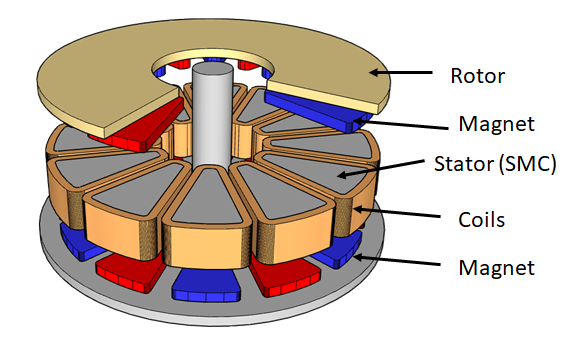
Axial Flux Motor Application - Low Profile & High Output
6. Conclusion: How Porite Can Help
As industries move toward smarter, more eicient designs, SMCs are becoming a go-to solution.
They're lighter, flexible, and more energy-eicient—perfect for modern applications like electric
vehicles, robotics, and advanced motors.
Porite Group can help you use soft magnetic composites in your next project, especially for axial
flux motors and stator/rotor designs made through powder metallurgy.
Visit: porite.us
Email: sales@poriteusa.com